Sunscreen FAQs: Your Questions About SPF, Zinc and Water Resistance Answered
Choosing and using sunscreen should not feel complicated. The most important points are to choose a product that suits your skin and activity, apply enough of it, follow the label and reapply when directed. Sunscreen should also be used with protective clothing, a hat, shade and sunglasses.
In this guide, we answer the sunscreen questions Australians ask most. For further industry education about sunscreen labels, ingredients and testing, visit the Australian Sunscreen Council. The Council represents sunscreen manufacturers, brand owners, formulators and suppliers; it is an industry body rather than a government regulator.
Quick sunscreen answers
When is sun protection recommended? Whenever the UV Index is 3 or above.
What should I look for? Check the SPF, broad-spectrum statement, active ingredients, directions, expiry date and AUST number. Choose water resistance when it suits your activity.
When should I apply it? Apply sunscreen generously before going outdoors, following the lead time on the product label.
How often should I reapply? Reapply at least every two hours and after swimming, sweating or towel drying.
Is sunscreen enough by itself? No. Combine it with clothing, a broad-brimmed hat, shade and sunglasses.
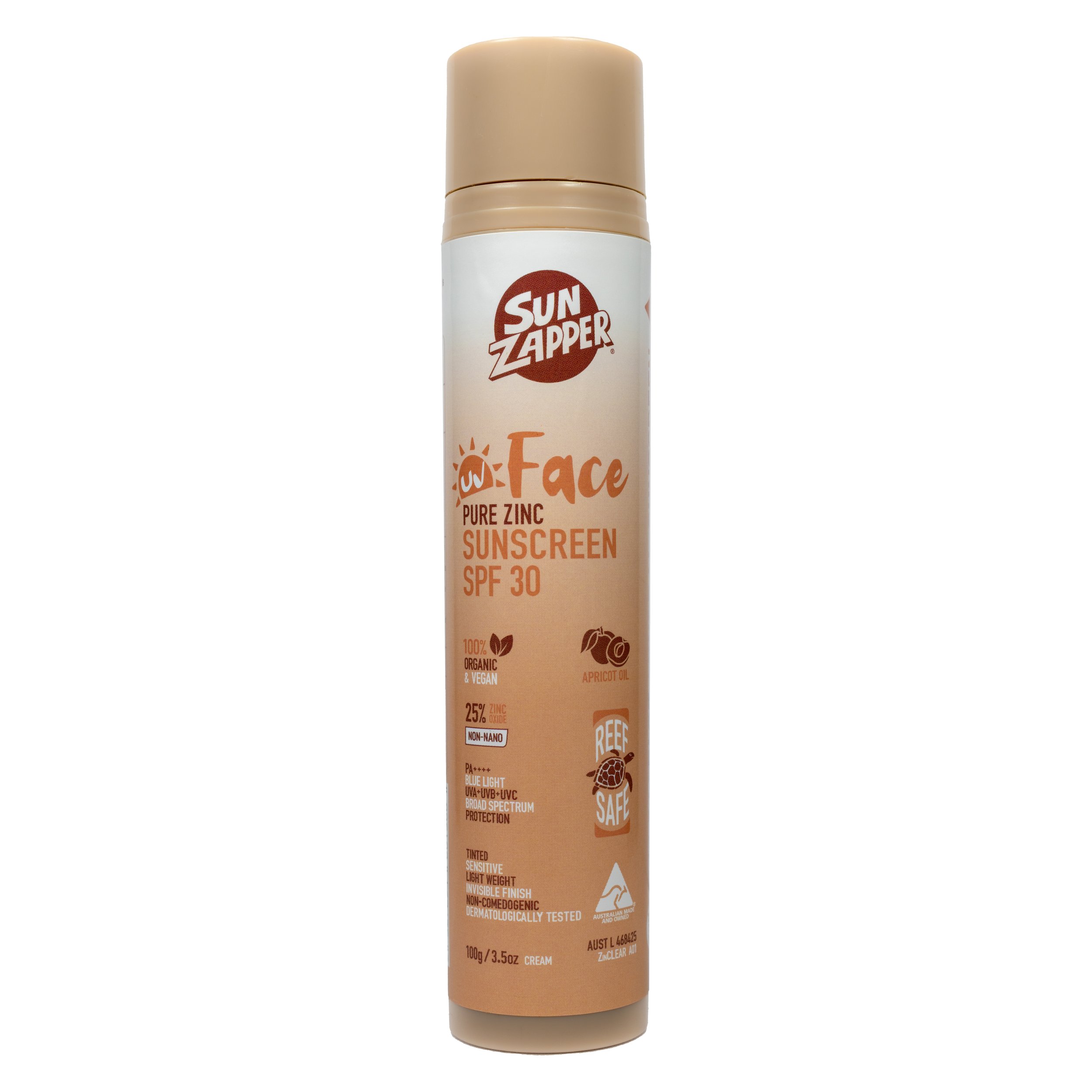
Sun Zapper Face Pure Zinc Sunscreen Cream SPF 30 uses 25% non-nano zinc oxide for broad-spectrum UVA/UVB protection without chemical sun filters. It’s reef safe, 100% vegan & organic, preservative free, paraben free, artificial fragrance free, and rubs in clear. Contains organic apricot oil and is designed as an “extreme element barrier” suitable for all skin types. Made in Australia.
25% Non-Nano Zinc Oxide
100% Vegan & Organic
Contains Organic Apricot Oil
Reef Safe - no chemical sun filters
SPF 30
Tinted
Artificial Fragrance Free
Paraben Free
Preservative Free
Rubs in Clear
Protects against UVA and UVB rays
Extreme element barrier
Suitable for all Skin Types
Safe for babies over 6 months old
MADE IN AUSTRALIA
100g
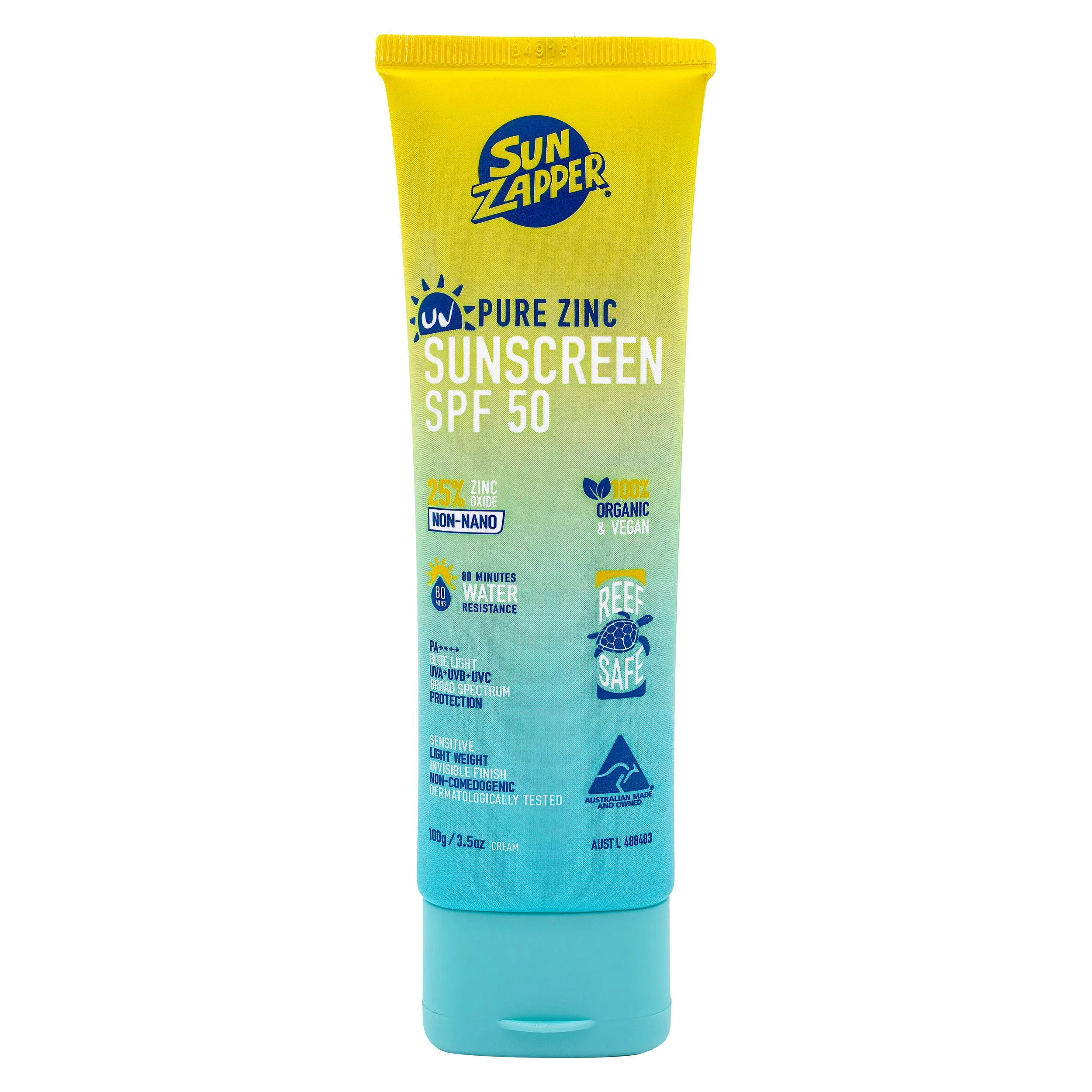
Sun Zapper Pure Zinc Sunscreen Cream SPF 50 is a broad-spectrum UVA/UVB mineral sunscreen made with 25% zinc oxide. It’s reef safe (no chemical sun filters), fragrance free, paraben free, and offers 80 minutes water resistance. Designed to rub in clear and act as an “extreme element barrier”, it suits all skin types and is safe for children over 6 months. Made in Australia.
25% Zinc Oxide
Reef Safe - no chemical sun filters
SPF 50
Kakadu Plum - high in Vitamin C, promotes collagen & skin elasticity
Jojoba - high in Vitamin E, softens & moisturises skin
Sea Buckthorn, Marigold, Chamomile - anti-ageing & ant-inflammatory
Fragrance Free
Paraben Free
80 Minutes Water Resistance
Rubs in Clear
Protects against UVA and UVB rays
Extreme element barrier
Suitable for all Skin Types
Safe for children over 6 months old
MADE IN AUSTRALIA
100g
Understanding sunscreen
1. What type of sunscreen should I choose?
Choose a sunscreen that is appropriate for your activity, comfortable on your skin and easy for you to apply generously. The Australian Sunscreen Council's consumer ingredient guide recommends checking the tested SPF and broad-spectrum claim, label directions, expiry date and AUST number rather than relying on front-of-pack marketing alone. Choose water resistance when it suits swimming, sweating or extended outdoor activity.
Texture matters because a sunscreen only works when it is used correctly. Sun Zapper offers sunscreen lotions designed for everyday wear, families, sport and water-based activities.
2. What does SPF mean?
SPF stands for Sun Protection Factor. It indicates how effectively a sunscreen helps protect skin from the UV radiation that causes sunburn when the product is tested and used as directed.
SPF is not a promise that you can stay in the sun for a set number of hours. The amount applied, missed areas, water, sweat, towel drying and reapplication all affect real-world protection.
3. What is the difference between SPF 30 and SPF 50+?
Both SPF 30 and SPF 50+ sunscreens can provide high protection when applied correctly, but SPF 50+ provides the higher labelled level. The Australian Sunscreen Council's label guide describes SPF50+ as very high protection and encourages consumers to look for a broad-spectrum SPF50 or SPF50+ product.
Whichever SPF you choose, do not apply a thinner layer because the number is higher. Correct application and regular reapplication remain essential.
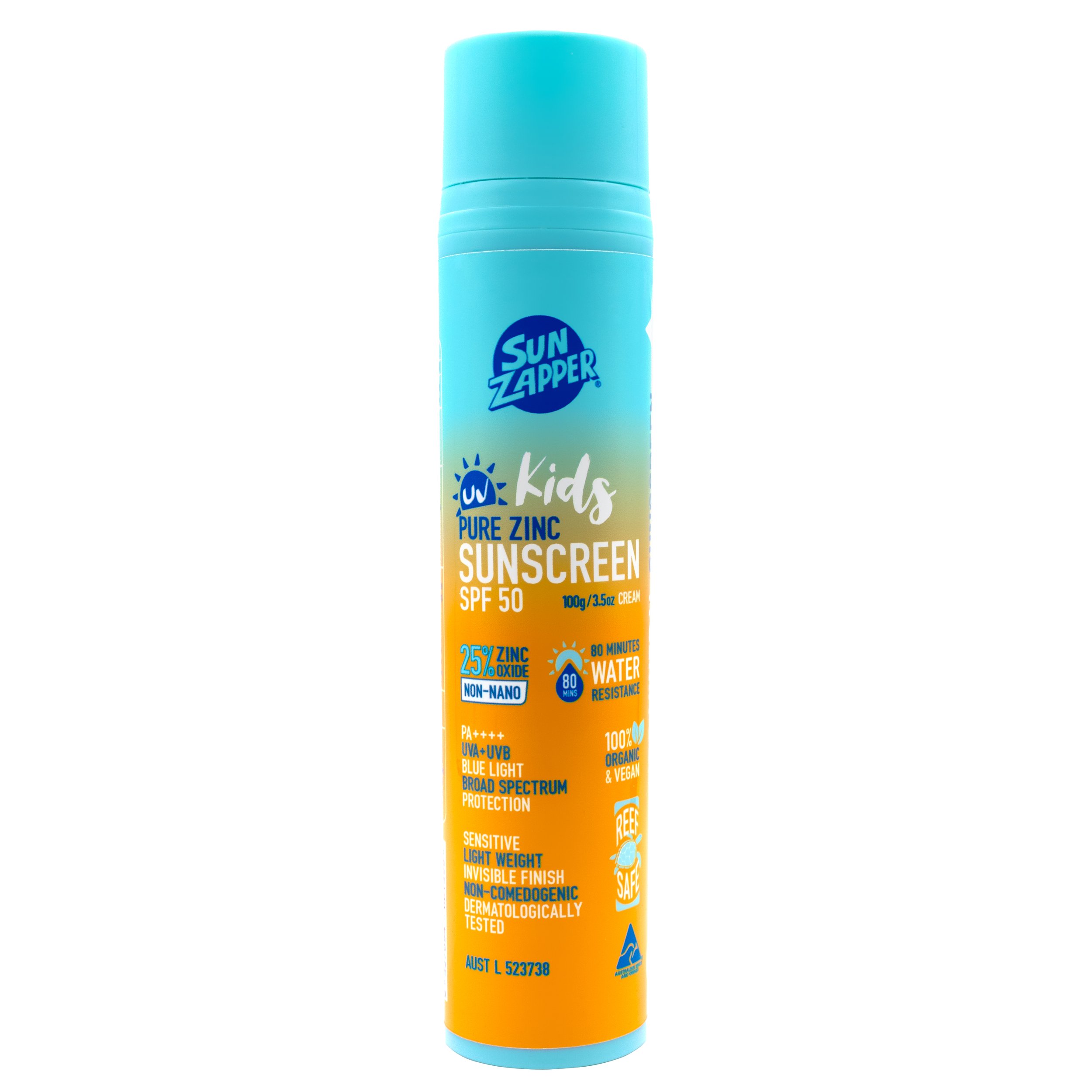
Sun Zapper Kids Pure Zinc Sunscreen Cream SPF 50 delivers broad-spectrum UVA/UVB protection with 25% non-nano zinc oxide. It’s 100% vegan & organic, reef safe (no chemical sun filters), preservative free, paraben free, and artificial fragrance free. Built for active outdoor days, it offers 80 minutes water resistance, rubs in clear, and works as an “extreme element barrier”. Suitable for all skin types and safe for children over 6 months. Made in Australia.
25% Non-Nano Zinc Oxide
100% Vegan & Organic
Reef Safe - no chemical sun filters
SPF 50
Artificial Fragrance Free
Paraben Free
Preservative Free
80 Minutes Water Resistance
Rubs in Clear
Protects against UVA and UVB rays
Extreme element barrier
Suitable for all Skin Types
Safe for children over 6 months old
MADE IN AUSTRALIA
100g
4. What does broad-spectrum sunscreen mean?
Broad-spectrum sunscreen is designed to protect against both UVA and UVB radiation. UVB is strongly associated with sunburn, while UVA contributes to skin damage and premature ageing. Both forms of UV can contribute to skin cancer.
Look for the words 'broad spectrum' on the sunscreen label and always follow the directions for use.
5. What is the difference between mineral and chemical sunscreen?
Mineral sunscreens commonly use zinc oxide, titanium dioxide or both as active UV filters. Other formulas use organic UV filters such as avobenzone or octocrylene. The Australian Sunscreen Council explains these ingredient groups and advises consumers not to assume that 'mineral' automatically means better or safer. Tested SPF, broad-spectrum performance, label directions and consistent use matter more than an ingredient shortcut.
The best choice is a compliant sunscreen that suits your skin and activity and that you are willing to apply correctly and consistently.
6. How does zinc oxide work in sunscreen?
Zinc oxide is an approved UV filter used in many sunscreens. It helps protect against UVA and UVB radiation and can be included in clear-rubbing lotions, traditional visible zincs and tinted zinc sticks.
Sun Zapper's range includes zinc-based formulas such as Pure Zinc Sunscreen Cream, as well as visible and tinted zinc sticks for high-exposure areas.
7. What does non-nano zinc oxide mean?
Non-nano describes zinc oxide particles that are not classified as nanoparticles. It is a formulation choice and is commonly sought by consumers who prefer mineral sunscreen products. It is important not to interpret 'non-nano' as meaning every nano zinc sunscreen is unsafe. The Australian Sunscreen Council's ingredient guide cites the TGA's review that zinc oxide and titanium dioxide nanoparticles in sunscreen are unlikely to cause harm when products are used as directed.
Applying sunscreen correctly
8. How much sunscreen should an adult apply?
Most adults need approximately one teaspoon of sunscreen for each arm, each leg, the front of the body, the back of the body, and the face, neck and ears. That is about seven teaspoons, or 35 mL, for a full-body application.
Apply sunscreen evenly to all exposed skin. Commonly missed areas include the ears, back of the neck, tops of the feet, around swimwear and along the hairline.
9. When should sunscreen be applied?
Apply sunscreen generously to clean, dry skin before going outdoors so you can achieve even coverage before exposure. Follow the lead time and application directions on your product label. The Australian Sunscreen Council's outdoor sun-safety guidance recommends applying before an outdoor shift or event begins and carrying sunscreen for top-ups.
10. How often should sunscreen be reapplied?
Reapply sunscreen at least every two hours. Reapply sooner after swimming, heavy sweating, towel drying or any activity that may remove the product from your skin.
Keep sunscreen somewhere accessible rather than leaving it in the car. Reapplication is much easier when the product is already in your beach bag, sports kit or work bag.
11. What does four-hour water resistance mean?
A four-hour water-resistance claim means the sunscreen has passed the relevant water-resistance testing for that period. It does not mean you can apply it once and remain protected for four hours without considering reapplication.
A water-resistance rating does not replace reapplication. The Australian Sunscreen Council advises reapplying sunscreen at least every two hours and more often when sweating. Reapply after swimming, towel drying or any activity that may remove the product, and always follow the label.
12. Is water-resistant sunscreen waterproof?
No sunscreen is completely waterproof. Water-resistant formulas are designed to remain effective for a tested period in water, but swimming, waves, sweat, rubbing and towelling can reduce coverage.
Always follow the label and reapply after activities that may have removed sunscreen.
13. Should I use sunscreen lotion or a zinc stick?
A lotion is generally the practical choice for covering larger areas of exposed skin. A zinc stick is convenient for targeted application to areas such as the nose, cheeks, ears and lips, and visible colours can make it easier to see where the product has been applied.
For outdoor activities, use the Sun Zapper approach: Step 1, apply sunscreen to exposed skin as directed. Step 2, apply a zinc stick to high-exposure areas, following the product label.
14. Can tinted zinc be used for beauty applications?
Tinted zinc can add visible colour while providing labelled sun protection, making it a practical option for beach beauty looks, festivals, sport and outdoor events. Apply it evenly and do not rely on a very thin cosmetic layer to provide the protection stated on the label.
For a warm, naturally tinted finish, Sun Zapper recommends the Extreme Tan 12g Zinc Stick SPF 50+. It can be worn as a visible tint on areas such as the cheeks and nose while following the application directions.
15. Can sunscreen be worn under makeup?
Yes. Apply sunscreen evenly as the final step in your skincare routine, allow it to settle, and then apply makeup gently over the top. Avoid mixing sunscreen directly into foundation or moisturiser, as this can make it difficult to achieve an even, correctly measured layer.
If makeup, sweating or touching your face disturbs the sunscreen layer, follow the label directions and reapply when required.

Sunscreen for surfing, sport and everyday life
16. What sunscreen is best for surfing
For surfing, look for high-SPF, broad-spectrum, water-resistant sunscreen that is comfortable enough to apply generously. Pay particular attention to high-exposure areas such as the face, ears, neck, shoulders and backs of the hands.
Sun Zapper options designed for active and water-based use include Extreme Zinc Sunscreen Lotion SPF 50+, Extreme Sports Mesh SPF 50+ and Ultra Clear Zinc SPF 50+. Pair your chosen lotion with an Extreme Zinc Stick on high-exposure facial areas and reapply as directed.
17. What sunscreen should I choose for outdoor sport or physical work?
Choose a broad-spectrum sunscreen with an SPF and water-resistance rating suited to your activity. A lightweight or sweat-resistant texture may feel more comfortable during running, team sport, outdoor work and hot conditions
Sun Zapper's Extreme Sports Mesh Sunscreen Lotion is designed to feel light and non-greasy while providing SPF 50+ broad-spectrum protection, sweat resistance and four hours of water resistance. Reapplication remains essential.
18. Can you get sunburnt on a cool or cloudy day?
Yes. UV radiation cannot be seen or felt, and temperature is not a reliable measure of UV strength. Cool, windy or cloudy conditions can still have UV levels high enough to damage skin. Check the UV Index rather than relying on how hot the day feels, and use sunscreen as part of a broader protection plan. The Australian Sunscreen Council's outdoor guide recommends combining sunscreen with clothing, a broad-brimmed hat, UV-protective sunglasses and shade.
19. Do I need sunscreen in winter?
Use sun protection whenever the UV Index is forecast to reach 3 or above. In many parts of Australia, including much of Queensland, this can occur throughout winter.
Snow, water, sand and other reflective surfaces can also increase exposure, so check local UV conditions before outdoor activities in every season.
20. Do people with darker skin tones need sunscreen?
Yes. Although natural skin pigmentation influences how quickly different skin types may burn, UV radiation can damage every skin tone. Everyone should use appropriate sun protection when the UV Index is 3 or above.
Tinted zinc options can help people choose a visible shade that suits their preferred look, but shade selection does not change the need to apply enough product and follow the label.
21. What should I consider for sensitive or acne-prone skin?
Look for a sunscreen that feels comfortable, check the ingredient list and follow the label. If you are concerned about sensitivity, test a small amount on the inside of the forearm for several days before broader use.
If a product causes an unusual reaction, stop using it and seek advice from a doctor, pharmacist or dermatologist. People using acne medicines should also ask their healthcare professional about sun sensitivity and suitable protection.
Children, storage and sunscreen safety
22. Can babies and children use sunscreen?
For babies and children, prioritise shade, clothing and a hat. Check label age directions and warnings, and ask a doctor or pharmacist if unsure. The ASC consumer guide recommends reading the full label rather than relying on 'kids' or 'sensitive' marketing. When sunscreen is age-appropriate, follow its label carefully. Sunscreen remains the last line of defence after shade, clothing and hats. A small-area usage test may help identify sensitivity before broader application.
23. How can I encourage children to wear sunscreen?
Build sunscreen into the routine before leaving home, let children choose a product texture or zinc colour they enjoy, and make application positive rather than rushed. Visible zinc can also help parents see which facial areas have been covered. Adults should supervise application so enough product is used and commonly missed areas are covered. Reapply according to the label, especially after swimming, sport or towel drying.
24. Does sunscreen expire?
Yes. Check the expiry date and do not use sunscreen after it has expired. Also replace sunscreen if its texture, colour or smell has changed unexpectedly, particularly if it may have been exposed to heat. Writing the opening date on the tube can help you keep track of older products, but the printed expiry date and storage directions remain the main guide.
25. Can sunscreen be stored in a hot car?
Avoid leaving sunscreen in a hot car. Follow the storage conditions and expiry date on the label, which the Australian Sunscreen Council highlights as key label information. Excessive heat may affect a product's texture, separation and performance, so keep sunscreen in a cool place as directed on the pack.
26. How are sunscreens regulated in Australia?
Primary sunscreens sold in Australia are regulated as therapeutic goods and must meet Australian requirements for quality, safety and performance. Therapeutic sunscreen packaging generally displays an AUST L or AUST R number, which identifies that the product is included in the Australian Register of Therapeutic Goods. The Australian Sunscreen Council's label guide explains why consumers should check the AUST number, SPF, broad-spectrum claim, active ingredients, warnings, directions and expiry date. Always buy sunscreen from a reputable source, read the label, check the expiry date and follow the directions for application, storage and reapplication.
27. What should I check on a sunscreen ingredient list?
Start with the active UV filters, then check the SPF, broad-spectrum statement, AUST number, full ingredient list, warnings, expiry date and directions for use. The Australian Sunscreen Council's seven-question ingredient guide explains mineral and organic UV filters and cautions against treating broad marketing terms such as 'natural', 'non-toxic' or 'reef friendly' as substitutes for evidence and label information. If you experience a skin reaction, stop using the product and seek medical advice. A different formula or ingredient combination may suit your skin better. Follow current label directions and official regulator advice if an ingredient is under review.
The most important sunscreen is the one you will use correctly
No sunscreen can protect skin if it stays in the cupboard or is applied too thinly. Choose a formula that suits your skin, lifestyle and activity, then use it generously and reapply according to the label.
For help choosing a formula, visit the Ultimate Sun Zapper Sunscreen Guide or browse the full Sun Zapper sunscreen range. Sun Zapper has been making sun protection in Australia for more than 30 years, with products designed for families, surfing, sport and everyday outdoor life.
Remember: sunscreen is only one part of sun protection. Combine it with protective clothing, a broad-brimmed hat, shade and UV-protective sunglasses. This article provides general information only; follow the product label and seek medical advice for individual health or skin concerns.
Sources and further reading
Australian Sunscreen Council: About the Council
Australian Sunscreen Council: Sunscreen Ingredient Questions for Australian Consumers
Australian Sunscreen Council: Outdoor Sun-Safety Guidance
Australian Sunscreen Council: Articles and Consumer Education